Monday, April 18, 2022

Achieve Peace of Mind


            The possible meanings for Heian as presented by Rob Redmond in his book “Kata the Folk Dances of Shotokan” are easy, basic, calm and peaceful. Although there are many speculations as to what meaning should be applied, each meaning is appropriate. The Heian Katas build the foundation or the basics. It is believed to have been made by Master Anko Itosu to prepare students for the

Pinan Kata created by Master Anko Itosu


more complex Katas so therefore, they are easier compared to what are considered as advance Katas. Master Itosu originally called it Pinan which is the Chinese pronunciation of its Kanji or characters. It means “safe” or “free from harm.” As a student of Master Itosu, Master Gichin Funakoshi may have had the same principle in mind when he renamed the Katas to Heian. Master Funakoshi has specified Heian to mean “Peaceful mind.” These five forms contain fundamental self defense techniques which as he has mentioned in his book Karate-do Kyohan that “having mastered these five forms, one can be confident that he can defend himself competently in most situations”. 


A lot of people question where Master Funakoshi got the word “mind” and added it to peaceful because there is no Kanji for mind in the Kata's name. For one thing Peaceful mind does make more sense than just “peaceful” when you want to convey confidence in self defense. It may also be  appropriate to interpret it as having "peace of mind". Also, to effectively use Heian techniques in a self defense situation will require a strong but calm and clear state of mind.

          To have peace of mind does not mean that our environment or surroundings have to be peaceful and quiet. We should be able to have peace of mind amidst the chaos and the noise that exists in our world. Amidst terrorism, violence, stressful work, traffic and many other bad circumstances, we should be able to live our lives to the fullest. The mastery of the Heian Katas can develop a cool calm spirit. In order for someone to have confidence in a fight one must be able to handle stress and pressure. In Kumite you should not think about winning or losing; instead your mind is focused on your opponent and on the ongoing fight. In self defense, we should not think about dying or living, getting victimized or not but rather we should be focused on what is happening in our surroundings (Awareness), when attacked our mind must be in the fight or  escaping from danger. So one must be totally aware of the situation he is in. We do not think of the past or the future, no judgement; so we live in the moment with a clear and open mind, at peace with what is, hence “peaceful mind”. 

          In the tournament your mind is in your one minute Kata performance or in the three minute Kumite bout and not anywhere else. You do not think about how you lost or the injury you got from the previous tournament or even the point he just got seconds ago because those are in the past. You do not worry about losing, getting hurt or even getting excited thinking you can easily win, because those are in the future. This kind of mind causes anxiety, stress, fear, complacency and it hinders proper action. The mind should be exactly where you are which is in the fight. I once joined a minor competition in conclusion to a Karate camp in the U.S. it was a traditional tournament so my

Heian Nidan

 opponent and I performed at the same time, side by side. After shouting the Kata which was Tekki Shodan I remembered glancing at my opponent who was much older than me; I moved and started at the wrong side. I realized my mistake and very quickly decided to continue and did not disrupt the flow of my Kata. I ended facing the opposite side. I lost and I was embarrassed. My mind was seconds ahead from the present moment and got so distracted. I learned from my mistake. 

         In our lives our present takes on different forms. Our present is our current circumstance. When the lock downs because of the pandemic started I experienced anxiety because I was thinking about how long before everything gets back to the real normal, I could not accept the "new normal", I was also thinking about what was going to happen to my kids (uncertain future). I was also missing friends, dojo training and my normal routine (fixated in the past). We have to have acceptance of our current circumstance and be able to act on the things that we can control. I accepted the "Pandemic life" and no longer resisted. I exercised and trained Karate on-line and by myself. I was grateful for  the positive things like having more time for family, being able to fix the house, there was no traffic and I connected to others who were experiencing depression due to the pandemic. So I learned that when we accept our present circumstances we will not miss out on the good things that come our way and the good things that we can provide others even at a very difficult time of our life, we will be thankful and when we are thankful we are happy. 

      Our present is also in the form of who or what we are and where we are right now. I used to think that someday when I become rich I will be able to help the poor. Then I learned from church that we can serve where we are right now. So now I have a better understanding of this principle of being in the "now". Whatever our roles are right now  we have to "endeavor"; be the best in that role as we can be. For the religious serve Him and serve others, if not then serve humanity. As a student serve there, as a father serve there; as a lawyer, doctor or teacher, as a Sensei, as an employee or an employer, live and serve where you are right now. We do not hold the missed opportunities in the past and do not wait for what we can do in the future, because if we do our best in our present

Knee kick from Heian Yondan

ordinary life. the small things make a huge difference. We will also grow our relationships which is also a part of our now. Because having developed awareness, we will not only be able to recognize dangers and intuitively detect threats; we will also be able to be humble and compassionate. We will be able to understand the needs of others and recognize opportunities. A practical example is when we listen to people with empathy. You should be in the moment never preparing for what you are going to say or let your mind wonder off, not being biased in your opinion or not passing judgement right away. One lets go of pride and tries to put himself in the other's shoes. Then we can truly have an understanding. Lastly, our present is today. We can waste it or live it. Just like a duel to the death there are no second chances. There might be a tomorrow but today is gone forever and it can never be brought back. If today is so bad or full of challenges, we do not have to lose. Always end today with a win.

      The Sensei initiates the principle of peaceful mind (Heian) to beginners. On a beginner's very first day he learns mokuso or seated meditation. Mokuso is how the student learns to put his mind to the here and now; to clear one's mind for training. He sets aside his problems from work or any distractions from outside the dojo. He sets aside any expectations or worries about training. The mind should be in the moment which is Karate practice. Then the student is taught a Heian/Pinan Kata. He first learns the technical skill (Kata sequence and details of techniques), then the effective use of the technique for self defense (Bunkai) and finally what most of us instructors neglect is to teach the Kata as moving meditation. We should allow the student some time to practice his Kata without thinking about whether his stance has correct weight distribution or without him constantly checking his form in the mirrors. But instead let him just feel every movement he is making, his mind is in the doing of the Kata. Explain and guide the student's mind to handle stress and pressure. Make the beginner perform alone in front of the whole class. This will prepare his mind before taking his kyu exam or joining a tournament. By developing "Peaceful mind" it will enable us to not only cope but to thrive in life. 

"You are too concerned with what was and what will be. There's a saying: Yesterday is history, tomorrow is a mystery but today is a gift. That is why it is called the present." -Master Oogway Kungfu Panda


Sunday, November 28, 2021

The Artist within the Martial Artist

        Merriam Webster defines an artist as one who creates art and is a skilled performer. Google dictionary defines art as "the expression or application of human creative skill and imagination, typically in visual form such as painting or sculpture, producing work to be appreciated for their beauty or emotional power". Also as various branches of creative activity such as dance, music and literature. Karatekas and Martial artists know that Karate-do and other Martial Arts (Budo) are an art form no matter what other people might say. Bruce Lee says that " Ultimately Martial arts means honestly expressing yourself". Just like other performing arts such as Dance, Theater or Music, it requires creativity and technical skill to express one's self and move others. The Kata is a very important training tool to develop techniques.  
Folk dancers preserve tradition
 and show case culture. 
       Performing Kata allows us to preserve tradition; culture and   present it to the world. Every organization has their own   standard way of  executing each Kata; so does JKS. As   students and practitioners  we should be obedient in learning   the standard because it will build our strong foundation. The   standards will also provide us understanding on how our organization interprets each Kata. To exercise one's creativity and self expression in Kata is to be able to give one's own rendition or interpretation of the Kata, but only when one has reached maturity, have strong foundation and has reached an advanced level of skill. Also to become an artist we should be able to find our own style within the Shotokan style like the famous Tatsuya Naka, and even go further and follow the example of our founder Master Tetsuhiko Asai, like him we can express our creativity by making our own Kata. A Karateka should be like a painter. The painter is given a photograph by his client and he paints a portrait. The portrait is not an exact replica of the photo but is done with the artist's own rendering. He also of course paints his own original work, exhibits and sells his paintings even if their paintings do not become locally or world famous. The artist is not content with just painting replicas of     others' original work, they create their own master
Kata is a Performance art as well
 as a Sport. It is the core of Karate 
tradition and culture. 

  pieces. Once a Karateka has reached a level of expertise and     has been training and honing his craft for many years then he   should follow the path of Master Asai and the other artists who   have gone before him like Master Itosu who created the Pin-ans,   Master Funakoshi and his son who created Shotokan, Master   Nakayama who created sports Karate and published the Best   Karate series. We hold ourselves back from becoming an artist.   Even though we have practiced diligently for many years. We do not consider ourselves experts in our craft. The" beginners mind" or the saying that we are forever students who still have a lot to learn is a state of mind that we should adapt when we are learning, so we can keep our egos in check and keep improving. But it does not mean that we should deny that we have become experts. Students may express themselves through "Shitei" or what is required (standard) but when one becomes a Senior; no not a senior citizen, don't wait that long. In my opinion 3rd Dan and above who practices regularly can start making innovations not only in their Kata but in their Karate as well. Because by this time they should have acquired technical proficiency. Another reason  is that we feel we are not authorized to make such innovations or maybe some feel that if they make such radical innovations their Karate will no longer be authentic. To be a custodian of Karate history and culture and an advocate of our organization's system is our commitment because we are part of the community. But being an artist is more personal. A Karateka can be both. We can conform; preserve tradition but we do not lose ourselves. Not being able to be true to one's self is weak but not being able to respect the ways of the organization and learn from it is prideful. Even those who practice their own Martial art without a formal organization had sought teachers, mentors and groups to learn from and strengthen their foundations.

      Self expression is not only when performing a traditional form or Kata but also in sparring or Kumite. Millions of people watch Boxing or MMA and are entertained by the brutality of the sport. They see who has more points, they see who is getting beat up, who 

Kumite is an expression of movement
as your opponent is moving

 got knocked out but Martial artists or even real fight enthusiasts   would see "a beautiful uppercut", an excellent arm bar or a great   footwork. A Kung-fu teacher once watched a Kumite event and   at the start of the bout he predicts the winner and he guessed   right. He was asked how he knew and he said he looked at the   footwork. We see the timing, precision and the quality of the technique executed by the players or fighters. The fighter or player's expression of himself is when he moves as his opponent moves. 

       Lastly, the artist may express himself through Bunkai or applications of the Kata. I think it is great that the WKF included Bunkai presentation in its tournaments. Sports Karate Bunkai is a great performance art itself. It demonstrates the creativity of the choreographer, 

Two different creative
expressions of Bunkai

the skill and talent of the performers that excites and thrills the audience. It is more theatrical, acrobatic and athletic which makes it so spectacular to watch. The other type of Bunkai is the practical applications of Kata for self-defense. Self defense Bunkai has only one criteria to follow and that is, it should work in a real- life scenario. So the beauty of Karate and other traditional combat arts is that there are several ways to express yourself as an artist; not just through sparring or consensual fighting but also in Kata and its application. But the most excellent expression of Karate-do is when it manifests in everything we do. Life is art. 

His gift our skills.


Thursday, October 21, 2021

Turn your disadvantage into an advantage

     The Kata Bassai is believed to have been created by Master Sokon"Bushi" Matsumura. kJust as in any Kata, we do not know the purpose and the application that was intended by its creator. But with bits and pieces of information gathered by such authors like Dr. Bruce Clayton; his theory about the Shotokan fighting system, Master Funakoshi himself and from our knowledge of Karate history both from digital source and oral traditions, they have provided hints on the "probable" purpose and application of the Kata. We can use these information to help us come up with our own expression and practical interpretation of the Kata. The original name of the Bassai Kata is Passai. Master Gichin Funakoshi changed the name into Bassai which is the Chinese pronunciation because it would be pronounced Batsu-Sai in Japanese. The Kanji character for Batsu means “to extract” and Sai means to “to block”.  In Bruce Clayton’s book "Shotokan's Secret: The Hidden Truth Behind Karate's Fighting Origins" he theorizes that in military strategy this could mean to extract the principal away from danger or become a blocking force preventing capture of the principal; with this theory Bassai would be similar to Tekki Kata which can be used as a strategy for body guarding or third-party defense, by defending and extracting the person of importance away from harm. 

Third-party defense, VIP protection

            Master Gichin Funakoshi used the title “To penetrate a fortress”. He opted to use the Chinese pronunciation, where in “Ba” means “to seize” or capture and Sai meaning “a place of strategic importance” or fort. He also said that in the Kata, the shifting of the blocks represent the feeling of turning the disadvantageous to advantageous and that the Kata implies the will of breaking through the enemy’s fortress. Dr. Clayton in his book interprets this teaching as penetrating through a violent crowd or mob. Being at a disadvantage facing multiple attackers, you use weakened opponents as cover or shield just as in Tekki Kata and therefore the mob becomes your tactical advantage. In a one on one fight with a formidable opponent, you must first break his will to fight not just through strong or superior technique but by gaining tactical advantage and having the stronger will or spirit. 

The military or police would conduct raids to enemy strong holds with speed and shock elements. They would breach fast, shouting loudly, employ flash bangs, smoke and fragmentation grenades. Their tactical maneuvers can turn their disadvantage into an advantage, like if they are up against a larger force or if the fight is in confined spaces (Close quarter battle). They would attack the enemy hideout hard and fast with overwhelming force. Such is the essence of Bassai. 

Raiding a stronghold is fast and with
 overwhelming force.


Turning the disadvantage to an advantage is to have the mind develop “Tactical awareness”. In self defense we must educate ourselves of the different tactics or modus of criminals so as to avoid being a victim. Counter criminal tactics and be a hard target. Know where we should sit or position ourselves so that it is safer, what are possible weapons within your surroundings, who are your connections in case you’ll need help, where do you run to when you escape (exit points), where can you hide (cover and concealment). This is the mind of Bassai.

These principles of combat in Bassai can be applied to one’s daily activities. Be creative and turn a disadvantage to an advantage, turn your weaknesses into strengths. If you make mistakes or fail, make it an opportunity to learn; use your failure to become better and stronger. If you had a bad or painful experience, heal your wounded heart and use your scars to help and to heal others. Acknowledge your weaknesses so you can focus on your strengths. Employ your will to overcome difficult tasks or challenges with the same spirit as a warrior breaking through a fortress. Seize or capture opportunities that would eventually lead to the accomplishment of your goals. In our business dealings we must have tactical awareness such that we would not be fooled or taken advantage of


       Control the pace of your activities, finish your work early if not on time and surprise them, deliver shock and awe; always make an impact. The high ground is an advantageous position. Always do your best and aim for that high position in your organization.
             Master Funakoshi says that the
             combination of blocks conveys 
        the feeling of turning the disadvantage 
        to an advantage.

Practically it will be harder for people to mess with you when you are in a high position but more importantly being in a high position means you have more responsibilities, more resources and power to help others, to do more for your community or organization, to empower your people and to serve. The high ground is not about pride but of humility and benevolence. Strive to have a strong mind and spirit that overcomes the fortress in your life.


He is our advantage.


Tuesday, August 24, 2021

NIJU KUN No.9

            “Karate takes a lifetime of practice”. This statement can be very daunting not just for our students or Beginners but for Black belts as well. Karate practice requires commitment. To continue to pursue this path is a choice that each of us has to make. Some students when they’ve reached a certain level quit because they’ve lost interest or they stopped for a time and they feel they are far behind, comparing themselves to their peers who have advanced both in rank and in skill, thinking they could never catch up; so they quit. Those of us who made it to Black belt Sho Dan rank had to renew 

Practice to become the best athlete 
that you can be.
  that commitment to the path of Karate-do. Earning a Black belt signifies another beginning where one starts to truly learn what Karate-do is all about.     But life catches up with our passion. Got married, started a family, busy with     studies, busy with career. Priorities change, time for Karate and our     organization had been cut down and for some; there seem to be no time at all.   There are some Black belts who lost interest in the art of Karate and found   another passion. Should they decide or find their chance to go back to training,   the JKS-KDA doors are wide open; let them know that we are more than glad   to welcome them home. For those who leave because they lost interest in   Karate and found other passion, we wish them luck on their new path and we are happy to know that their knowledge of Karate will greatly help their lives; also we are glad that they have been a part of our journey as well.

           Those whose passion for Karate still boils like hot water, who choose to continue on the path and those who go even farther and choose to be a teacher of Karate-do, you must remain faithful. Our daily lives challenge our commitment and it is even more challenged during this time of Pandemic.
Master Tetsuhiko Asai is
 one of the greatest Martial
Artist of our time.


 To overcome your challenges you have to stay motivated to practice. We must make the time to practice on our own and to practice with our Karate family. Practicing with our family by attending Dojo practice or Black belt practice enables us to learn from our chief instructor David Lay Sensei and from each other. It also fosters our camaraderie. During this Pandemic we have to adapt. On line classes and Black belt practice is the best that we can do at this time. I myself could not practice as often as when I was still single, I am not as active in our organization unlike before I started a family. I do understand how hard it is to maintain commitment to Karate as a way of life. Can I share with you how I stay motivated to practice? When I was young, competing in Sport Karate motivated me. I wanted to excel as an athlete; now Karate as a Martial art motivates me to practice. Just like other masters of the arts like Levi  Celerio of music or Fernando Amorsolo of  painting, I want to be an excellent artist through Karate-do. Second motivation is self-defense. I want to keep my mind and body always ready to defend myself and the people around me. Third motivation is I want to  be healthy and physically fit to face daily
The journey is personal but its great to have
people travel along with you.

challenges and to have longevity. And there is not a better time to be healthier both 
mentally and physically than in this time of Pandemic. Fourth motivation is being a teacher. Teaching students entails a greater responsibility. I know I can teach     Karate but I have to keep attending Black belt practice because I   have to keep up with technical updates and for my lessons to be aligned   to our system; also to develop both my teaching and Karate skills   further. Lastly I’m always excited to practice because of the fellowship.   I want to constantly build my relationship with you guys. You are   family. The more we grow our relationship the better we can appreciate one another. We will be more understanding of our differences, we can appreciate each other's negative traits as well as the positive. Our friendship entails mutual trust and respect. 

                For our Karate family members to continue to have a place to come  home to, to continue supporting those who embark on this long journey and to promote this wonderful martial art are my motivation to share time and talent to Dojo service. I hope these can help whenever you face challenges to practicing Karate-do. Do not let it turn cold.
Deeper relationships promote harmony


As One for His Glory.

Saturday, July 3, 2021

“It’s not a Gym it’s a DOJO”

Shomen also known as Kamiza
      Every Karateka would know that the word Dojo means “a place to learn the Way”. However, There are many who do not know the different parts of the Dojo, except for the Shomen or the front wall of the Dojo, which is often a part of the formal bowing done at the start and at the end of training. In order to fully grasp the attitude, the discipline and the conduct by which to train in “budo” or martial arts like Karate, it is important to know the different parts of the Dojo for it can help those who enter in their quest to truly learn budo, or in our case Karate-do.       
    The Kamiza, more commonly known as Shomen meaning “upper side” is the Dojo’s front wall where the Shinto shrine; sometimes an offertory altar or simply a picture of the style’s founder is placed. It does not matter what religion one has because the Kamiza simply guides students  and serves as inspiration to pursue not just physical goals but spiritual goals as well. The Kamiza should give the Dojo that spiritual atmosphere. Such is why a true Dojo is temple inspired; It is a place to cultivate virtues like respect, humility, patience, perseverance, self control, fortitude and compassion. 

          The Shimoza is the “lower area” where the entrance is located. Associated on this side are intellect and human interaction. Humility, discipline and awareness are associated on this side. At the entrance students enter with the desire to learn. As they enter, students must leave behind their preconceived ideas about what the training will be, about their own strengths and weaknesses or expectations. One must have a clear and open mind to learn the art of Karate-do or any martial art (Budo). The student should also leave behind whatever problems or distractions he may have like problems at work or school, over excitement with someone or something.To just be in the moment, so that he or she may have focus and concentration in training. At the entrance the students bow before they
Parts of the Dojo

enter the training area not just to honor the place of learning but to enter it with humility and leave the ego behind. Once inside, the students must develop trust with one another and because of humility they should be able to train safely and be sensitive to fellow students. Discipline is initiated at the Shimoza. They learn to conduct themselves with dignity by following the principles of etiquette. The discipline and proper mental attitude must continue even when one exits the Shimoza door. 

          The Joseki means “upper lateral” and it is the senior members’ side which is at the right side of the Dojo. The values like virtue and charity are associated in this side. There should be a sense of commitment for the senior members to lead and be responsible in helping the junior members learn. They are obligated to be good examples to the juniors. The seniors’ side must have a high level of intensity during practice. At the Joseki, the juniors are able to observe and emulate the seniors. The Shimoseki is at the left side of the Dojo and it is the side of junior members. This side is characterized by integrity or rectitude because the junior members are expected to always give their best. From this side, the juniors can observe the seniors and learn from them; also to see if the seniors have the integrity to give their best too. 

           The center of the Dojo is where all the members of different levels meet. This center space is known as “Embujo”. Em means “to act”, bu means “martial” and jo means “place”. At this space everyone is expected to train hard and always do their best. The essence of the center of the dojo is the attitude of being in a life or death situation wherein there are no second chances; no next time. One has to seize the moment and bring out only one’s best. Specially on an ordinary day like when you attend the usual Saturday practice. You were off and you felt you have not been able to do very well. You're thinking that you will just make it up next Saturday training. Yes there will be many more Saturdays to come but that Saturday, that day itself is done and gone forever. The Embujo is a place to do martial training. Actions are the only thing that matter and not talking or theorizing. At the Embujo there should be no excuses, no complaining and whining. 

    Knowing the values represented in each part of the Dojo are vital not just to aid the Karateka to develop his technique but to improve his character as well. The discipline and the attitude that we acquire in the Dojo which help us to learn and hone our skills should also be applied once we step out of the Dojo. Human interaction requires correct etiquette, virtues of humility and compassion initiated at the Shimoza. Be inspired and get motivated by the Kamiza to seek spiritual growth, to perfect one’s character through everyday life. Be observant and emulate those who succeed and always bring out the best in one’s self just like being in the Shimoseki. Be able to always do your best, to have integrity, lead by example and empower others as if being at the Joseki. Avoid making excuses for one’s short comings or failures and just do what is needed to be done, accept responsibility and be accountable. Live as if there will be no tomorrow. This does not mean to indulge in an irresponsible, hedonistic and care free living. We must seize the moment.  At the Embujo it is life or death; there are no second chances. Be grateful and happy; we must grab the opportunities that bring us closer to our goals, be the best that we can be, to be great at what we do; to live one’s life to the fullest and have no regrets. Such is the attitude learned at the Embujo. By understanding what each part of the Dojo represents, we can practice Karate outside the Dojo.

Source: “In The Dojo” by Dave Lowry


The World is our Dojo.


Thursday, January 14, 2021

The Way of Empty hands vs. Knife

      Back when I was a brown belter we had knife defense as part of our curriculum. I've also read books  and I have seen a lot of demonstrations showing techniques for knife defense. For defense in a fist fight we learn what techniques and strategies will work because we either experienced a real fight or simulate it through Kumite, with real fight intensity even as we keep our training safe. Although there maybe some Martial artists out there who have experienced a real knife attack and survived, I am sure that a lot of Karatekas like me have not experienced it; thank God. I had no idea how a real knife attack should be. I have seen a lot of fist fights growing up in all boys schools and walking the streets of ghetto Manila. But I have not seen an actual stabbing (Thank God again). Most of us have come up with knife defense techniques and strategies based on assumptions. Most knife defense skills being taught or demonstrated will get students or participants killed rather than increase their chances of surviving the attack. This is because we tried to deal with the threat of knife attack without truly learning or understanding it. While I greatly appreciate knife defense techniques that look good in demonstrations, defending against a real knife attack is messy but effective. Today there are lots of materials in the internet to help us learn. There are a lot of videos/vlogs about the realities or as they say “the truth about knife attack”. We can also see real knife attacks caught on cameras. I took some lessons in Kali to help my research in understanding the blade. Learn from the experts of knife fighting and adapt what you learned into your Karate. Okinawan karate always had the study of weapons known as “Kobudo”. Arnis systems start from weapons and progress to empty hands. Our Karate is empty hands and could progress to weapons/ Kobudo. We can apply our Karate in wielding a knife, carrying a gun or blunt objects. While empty hand defense is indeed a disadvantage against any weapon, it is still prudent to develop the skills for it. Here in the Philippines it is expensive and complicated to carry a gun unlike in the U.S. where they have a right to bear arms and civilians can easily buy and carry around pistols to automatic rifles depending on state laws. And if you are a law abiding citizen be advised that it is against the law to carry knives and blunt objects (Batas Pambansa bilang 6). Thus we should be able to rely on our

The characteristics of a
real knife attack

Empty Hands. I do not want to offend anyone but we should all be open minded and reconsider what we learn and teach, because unlike a fist fight, dealing with a knife is truly more fatal. The goal is to survive the attack, to come out of it alive and if you are truly good or lucky, maybe you escape without a scratch. If you have seen videos of real knife attacks, the energy of the attacks are very intense and violent, so it is better to accept that you might get cut as you fend off the attack. A knife attack is like a sewing machine because of continuous stabbing and slashing not just a single but with multiple stabs and slashes. The attacker will not leave his weapon arm hanging out for us to grab. The attacker does not wave the knife in front of the victim, he wants a surprise attack. He uses his empty hand to grab you and the attack is usually from close range. These are the things to consider when you are developing your techniques.      

Block and Counter strike
at the same time

     In order to prevent the "sewing machine"  or the continuous stabbing and slashing, block and counter strike at the same time or immediately after you block and check the weapon arm. Continue to attack vital areas until there is a chance to escape. If you are unable to escape, keep the weapon arm in check at all times. Your hand or arm should stick to it like glue. If you are able to grab the fist that holds the knife you can "return the blade" meaning you redirect the blade to cut or stab the attacker as he tries to free or pull back his weapon arm. Apply arm or wrist locks and take downs to control the attacker but you should only do this if you are bound by duty (for police or security) or if its truly necessary, otherwise just escape. Do not attempt to disarm; only if it is 

really necessary and that there is a clear opportunity to do so.
Keep the weapon arm in check

In Kumite we hone our techniques by doing drills then we pressure test it through real fight intensity (free style) sparring. Our knife defense should undergo the same process. Drill the techniques then practice with real life intensity and with training knives that will hurt like a punch when you get hit so that there is at least a threat of getting a bruise if the defense failed. Just like in Jiyu kumite, we put parameters to keep the real life attack scenario as safe as possible and preferably wear protective gears like head gear and an armor for the attacker; an eye protector for the defender. There are always a lot of "what ifs" meaning there a lot of variables and possibilities in Kumite or in any fighting. You just have to understand the principles and learn to adapt to your opponent or the situation. This is also true in knife defense. There are a lot of ways the knife attacker can react to your defenses so when he moves, you move. Protect your vital areas while you attack his. Be aware of what you can use in your surroundings as a weapon, preferably something that can provide good distance from the attacker like a long stick or a chair. Put something between you and the attacker like going around a car or a table. I was asked by a participant in a seminar why I kept kicking the attacker in the groin several times before going for the escape because like him we are nice and good people. We do not want to be violent but we have to in this case. A knife attack is very personal and very violent. The attacker can be psychotic, high on drugs or full of rage and adrenaline. and to be able to escape you must be able to give the necessary force. We certainly would never want anything like this to happen to us but as Martial artists it is always better to be prepared for this type of situation. 
Real Life Intensity Practice


Peace be with You.


Tuesday, December 1, 2020

Using Nagashi Uke and Maai


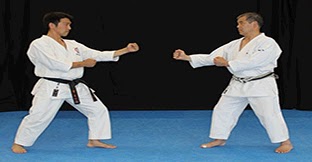
          The principles of Karate-do teach us to be Non-violent. We practice to be able to control our negative emotions like anger or fear, to swallow our pride, to respect other people and to be patient. All such virtues are to enable us to avoid conflicts. Karate is for self defense only and fighting should always be the last resort. The principles “Kata always begins with a block” and “In Karate never attack first”, does not mean that we should not strike first because there would be instances where we would need to strike first tactically. What they mean is that we should have the mentality of not being the aggressor, to have the attitude of avoiding conflicts and preferring peaceful solutions. In our daily life it is very rare that we encounter physical attacks, what we encounter more often are verbal attacks. There might be a harsh person in your life. He or she would always shout at you, curse you, offend or humiliate you and make your life difficult. Hopefully you have not punched the guy yet. Getting back at them, retaliate in every way, go to bed angry or sad is what we usually do. But what is the extra ordinary thing to do?

          If there is a harsh person or bully in your life, he can be your class mate, group mate, your Boss, a random angry guy, or a co-worker who taunts you or throws his verbal attacks at you, just deflect his attack. Let the attack pass through you and use his energy to counter. There was a story about a Karate master who went to an inn and he was met by a very angry guy who was jealous of him. The guy punched the Karate master and the Karate master deflected the punch, grasped the attackers hand and dragged him to a table and invited the guy to have a drink with him. The guy actually tried to physically harm the Karate master; but the attitude of the Karate master serves as a good example specially for verbal conflicts. There was also someone I knew who was very patient and when he heard that his older friend whom he calls Manong was bad mouthing him, he just told us not to mind Manong because he has a health problem and that he is already old. He was sincerely patient and understanding of Manong.

          So the first thing about deflecting a verbal attack is to check your pride and be humble. If the harsh person is shouting and cursing at you, you look at him or her and imagine that he/she is like a small toddler shouting and throwing tantrums because that is exactly how they are behaving. This way you will not be hurt because what you see is that your aggressor has the mind of a small child and that he must be dealing with far deeper issues in his life. If you have inner peace you will not

Having deflected the attack,
 you can choose your 
counter

let yourself be affected by their negative and aggressive actions. You just let the words and the deeds go past you, and just like the Karate master you redirect and counter positively. “Sticks and stones may hurt your bones but words should never hurt you”. You deflect and let it go past you, just let it slide through. You counter not by being aggressive but by being assertive and let them know that you don’t like how he or they treat you. You counter disrespect with respect, respond to cruelty with kindness. You cannot deflect effectively and respond positively if you have fear and insecurity instead of confidence and courage. How can we have courage and confidence? Keep practicing Karate. Developing your knowledge and skills turns fear into confidence. Developing our character through practice of Karate-do turns pride or insecurities into humility and compassion. In Budo, there is no room for fear or anger because it will hinder your correct action. In our life, fear and hatred shackles our mind and spirit. We are unable to move on and unable to do the right thing. We would do or say things that we will regret. 

    In Kumite or sparring we can disengage from our opponent to a safe distance from his attack while we recover, relax and calm ourselves. We rethink our tactics or change our rhythm. 

We can also distance ourselves from that harsh person
"You control the distance, you win the fight"

and de-stress, calm ourselves and make sure that we don’t tie ourselves down with fear or anger. Distancing ourselves from the negative person will allow us to choose better ways to react or handle the situation and a chance to recover from the hurt and get stronger. However, when we increase distance from our opponent in sparring we may be safe from attack but we also miss opportunities to attack. If we allow ourselves to stay distant, 
our mind and emotion may be safe from the negative person  but then we will also miss the opportunity to become a better person. We will not have the compassion for that person. Be in control of how you engage or disengage mentally and emotionally because staying distant is either being afraid or prideful. 

          I have not yet mastered this techniques of deflecting the attack and controlling the distance. There are still instances where I would blow a fuse and say or do things that I would later regret; there are times I am unable to take a step back and breathe to be able to think more clearly and calmly before I react or speak. The process of forgiveness for me is still way too hard that it is easier to just be distant and angry. Let’s keep practicing this techniques in our daily life until they become our natural response to verbal conflicts. Keep practicing Karate-do to improve our character. Practice makes perfect.


Love your enemy.